Field guide · updated 2026-08-10 · 6 min · 1,214 words
AI assistant vs AI employee: where the line actually is
The technology can be similar; the operating contract is not. Compare assistance, delegated workflow ownership, supervision, evidence and pricing.
Editorial position
aiassistant.sg sells integration in this category. Product mentions carry no affiliate or vendor compensation.
Review policy
Reviewed 2026-08-10. Source links below support details that may change.
The useful answer, upfront
What to carry into the decision
- “AI employee” is commercial shorthand for delegated, bounded workflow ownership — not a legal or human status.
- The premium should buy integration, state, exception handling, records and ongoing operation, not a job-title prompt.
- Supervision never disappears; it moves from approving each output to reviewing queues, exceptions and outcomes.
- A workflow should earn autonomy through observed evidence, starting with preparation and approval.
Section 01
Same anatomy, different working contract
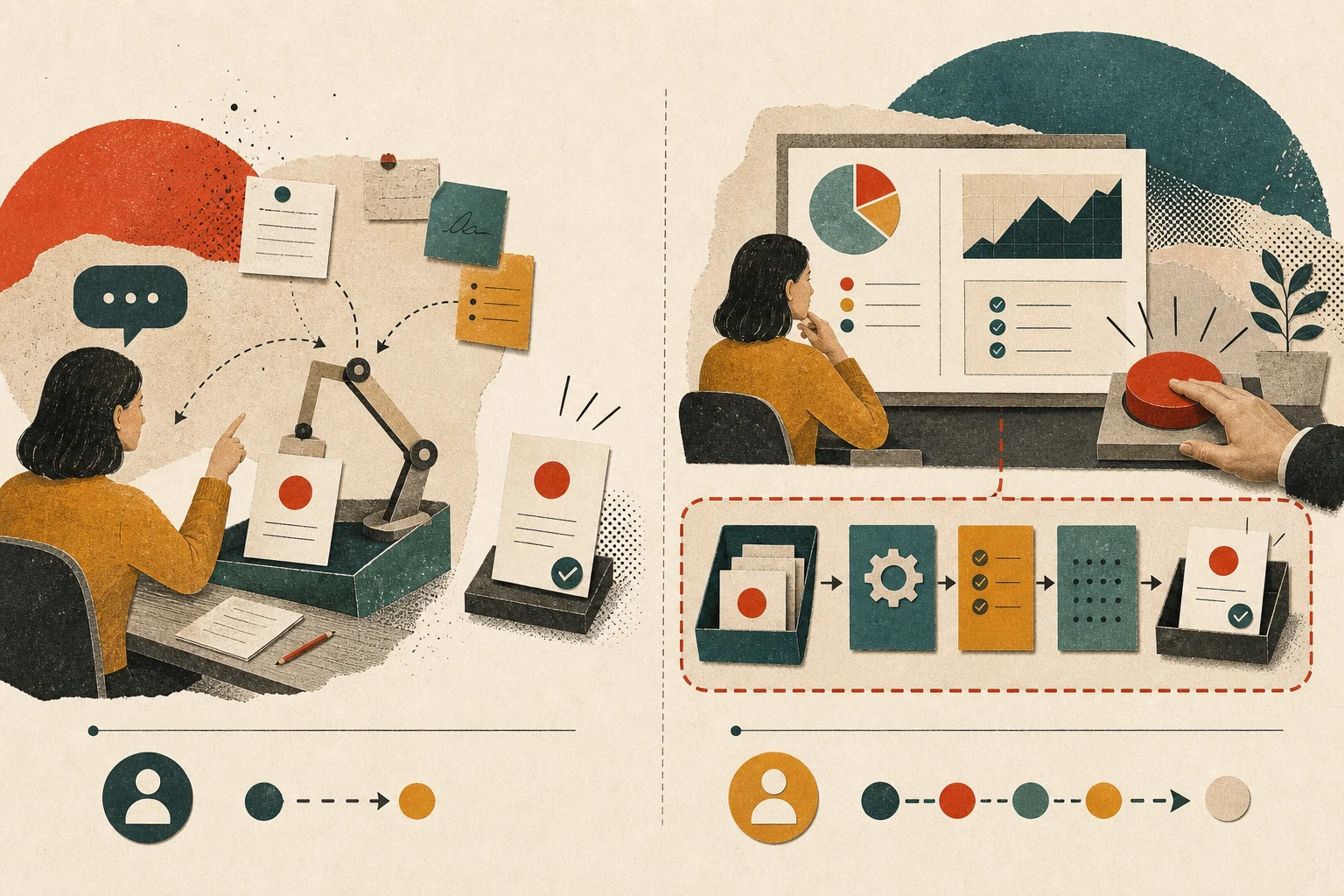
AI assistant and AI employee products can use the same underlying models, context, tools and connectors. The difference is the promise made about work. An assistant helps a person complete a task they still direct. An AI employee is sold as carrying a bounded workflow under standing rules, with a person supervising the system rather than initiating every step.
That phrase is metaphor, not transfer of responsibility. Software does not become an employee in the legal, ethical or managerial sense. It does not hold accountability, build relationships or recognise every reason a rule should be suspended. The organisation and its people remain responsible for the workflow and its effects.
Treat the label as a request to inspect an operating contract. Which events start work? Which facts may be used? Which decisions are deterministic and which involve a model? What can be done without approval? When must the system stop? Who owns unresolved cases? A provider that cannot answer those questions is offering assistance with employee-shaped marketing.
Working diagram
How the supervision contract changes
Autonomy changes what people review; it does not remove the need for review.
01
Prompt
A person initiates, supplies context and checks every output.
02
Prepare
The system collects context and drafts the next step for approval.
03
Act in a lane
Stable, reversible actions happen under written limits.
04
Manage by exception
People inspect outcomes, drift, blocked work and unusual cases.
Section 02
The delegation premium
A role-shaped deployment costs more because reliable delegation requires unglamorous work. The real process must be observed and written; sources need owners; systems need scoped connections; partial failures need recovery; exceptions need queues; and records need to answer what the system knew and did. That is operations and integration, not merely access to a stronger model.
OpenAI’s practical agent guide recommends using agents where nuanced decisions, difficult rules or unstructured data make deterministic automation insufficient, and retaining human intervention for high-risk actions or exceeded failure thresholds.[2] This is a useful commercial test: if ordinary workflow rules can handle most of the job, reserve the model for the ambiguous portion instead of charging model-driven prices for every step.
| Capability | Evidence | Weak substitute |
|---|---|---|
| Workflow ownership | States, completion rule, queue owner and service expectation | A job title in the prompt |
| Business grounding | Named sources, conflicts, owners and review dates | A folder uploaded once |
| Bounded action | Allowlisted tools, permissions, approvals and stop rules | A broad integration account |
| Recovery | Retries, partial-failure handling and a visible exception queue | Error logs only engineers can see |
| Evidence | Representative evaluations, correction trends and outcome review | A polished happy-path demo |
| Operation | Monitoring, change control, support and an exit export | A recurring fee labelled maintenance |
Section 03
Which work can be delegated
Good candidates are frequent, observable and recoverable. A lead-follow-up lane can expose whether a lead is new, waiting, due or handed over. An enquiry triage lane can cite approved facts and route unsupported questions. A document-processing lane can show extracted fields and preserve the original for review. The result can be checked without reconstructing invisible judgment.
Bad candidates are dominated by novel exceptions, relationships or irreversible decisions. Hiring, disciplinary action, financial commitments, safety judgments and advice that materially affects a person should not be delegated merely because the model can produce a plausible recommendation. The assistant may collect information and prepare options while a named person retains the decision.
The Singapore PDPC’s guidance on personal data in AI systems addresses accountability, notification, consent and data minimisation in relevant recommendation and decision uses.[4] A workflow involving identifiable customers or employees should document why each data field is needed and which person remains responsible for the consequential decision.
- Stable enough to describe, but contains language or variation that makes pure rules awkward.
- A completed outcome, overdue case and incorrect action are all detectable.
- Mistakes are reversible or intercepted at an approval checkpoint.
- The volume or delay is material enough to justify integration and ongoing care.
Section 04
How an AI employee should be evaluated
A role deployment should be tested as a system, not graded as a collection of attractive answers. Build a representative case set from ordinary work, difficult boundaries, stale information, missing fields, tool failures and adversarial inputs. Score the outcome, the path and the quality of the handover. A refusal or escalation can be the correct result.
Agent evaluations need several lenses because a final answer can look correct after a bad path, and a good path can still be blocked by an external failure. Anthropic’s agent-evaluation guidance distinguishes outcome, process and reliability signals, and emphasises tasks that are realistic enough to expose actual failure modes.[3] The lesson for a buyer is simple: ask to see the cases and scoring rubric, not only a summary percentage.
Step 01
Shadow the role
Observe real arrivals, decisions, exceptions and completion evidence before automating.
Step 02
Build the case set
Include normal cases, rare boundaries, bad inputs and system failures.
Step 03
Run in preparation mode
Compare proposed actions with human decisions and record corrections.
Step 04
Open one lane
Allow a stable, reversible action under explicit thresholds.
Step 05
Review outcomes
Track unresolved work, overrides, regressions and business effects at a fixed cadence.
Section 05
How governance changes with autonomy
Singapore’s Model AI Governance Framework for Agentic AI recommends assessing and bounding risks early, constraining access to tools and data, setting meaningful human checkpoints, testing throughout deployment and preserving human accountability.[1] Those ideas translate directly into an operating ledger for a role-shaped system.
| Level | Human checkpoint | Record to retain |
|---|---|---|
| Advise | Person decides and acts | Sources, recommendation and user correction |
| Prepare | Person approves a proposed action | Proposed payload, approval and final action |
| Act in a lane | Rule or threshold determines when review is needed | Input, rule, tool result and exception |
| Manage by exception | Owner reviews trends and high-risk cases | Outcome measures, drift, incidents and changes |
Section 06
The buying decision
Choose an assistant contract when the rules are still being discovered, volume is modest or judgment is needed message by message. Choose a role-shaped contract only when the workflow is bounded, the result can be observed, exceptions have owners and the organisation is prepared to operate the system. The honest first phase may conclude that preparation and approval are enough.
Compare proposals on the artefacts and operating obligations above. Pricing should separate a written setup scope and fixed quote from monthly care and third-party usage; it should also state what remains human. Our pricing page explains the shape of our packages, while the full AI employee guide gives a deeper procurement checklist.
↗Primary sources
Sources and verification
Citations in the article point to these first-party or authoritative references. Product details can change; the review date above is the verification date for this edition.
→Continue the field guide