Field guide · updated 2026-08-10 · 7 min · 1,478 words
WhatsApp AI for Singapore businesses: the integration behind the chat
What a useful WhatsApp AI assistant needs behind the conversation: verified sources, workflow state, CRM handoff, permissions, audit and a human owner.
Editorial position
aiassistant.sg sells integration in this category. Product mentions carry no affiliate or vendor compensation.
Review policy
Reviewed 2026-08-10. Source links below support details that may change.
The useful answer, upfront
What to carry into the decision
- WhatsApp is the channel; the source of truth, workflow state and ownership should live behind it.
- A useful integration keeps one small authoritative case record instead of copying whole conversations everywhere.
- Autonomy belongs in narrow, reversible edge actions; prices, exceptions, commitments and sensitive judgment remain human.
- The scope must cover platform rules, PDPA purposes, processors, access, retention, testing, monthly care and exit.
Section 01
The chat window is only the front door
A WhatsApp AI assistant needs more than plausible language. It needs a controlled path to the facts, workflow state and people that make a response useful. Otherwise the business places a conversational layer over the same dropped leads, inconsistent policies and invisible ownership it already had.
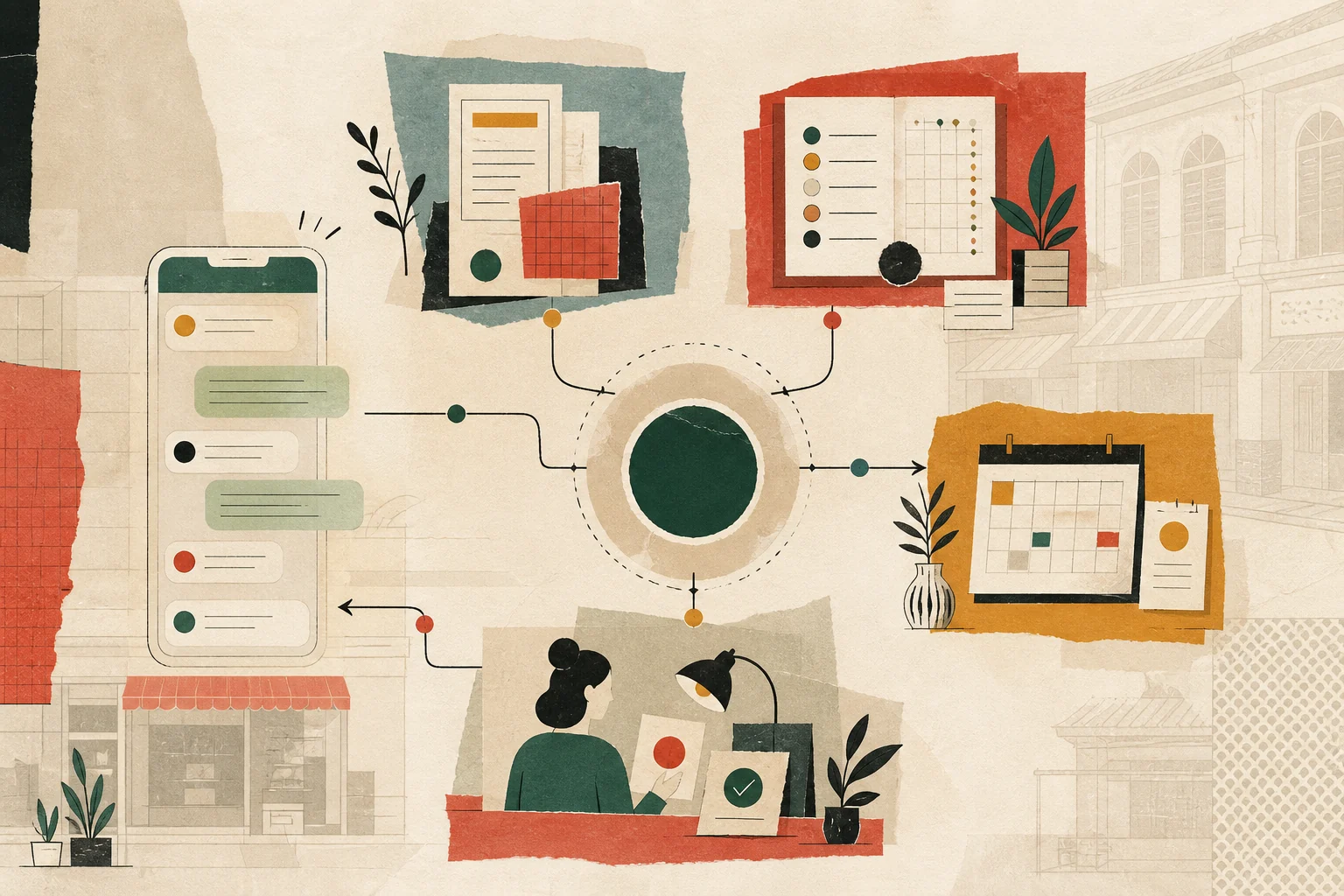
Design WhatsApp as a thin channel. The conversation stays readable there, while an agreed source of truth holds the lead, customer, task, appointment or order state. The assistant moves information and prepared actions between the two under explicit permissions. If the channel becomes the only database, staff eventually reconstruct business state by scrolling.
Meta documents business messaging through the WhatsApp Cloud API and the mechanics of sending messages.[1] Platform access is necessary but not the operating model. The implementation must still define message eligibility, templates where required, source support, customer expectations, staff handover and failure recovery.
Working diagram
The operating stack behind one reply
The model drafts or interprets inside a larger system of record, permissions and people.
01
Channel
Supported WhatsApp business identity, messages and platform rules.
02
Knowledge and state
Approved facts plus the case owner, stage, history and next action.
03
Decision and tools
Rules, model interpretation, approved connections and hard limits.
04
Human operation
Approvals, exceptions, source ownership, monitoring and customer accountability.
Section 02
The six components a credible system can show
Ask a supplier to demonstrate each component separately. Separation matters: it allows a source to change without rewriting the workflow, a permission to be revoked without deleting case history, and a failed connector to return work to people without losing the conversation.
| Component | Question | Evidence |
|---|---|---|
| Business channel | Which account, number, message types and platform rules apply? | Account ownership, permissions and current platform documentation |
| Verified knowledge | Which products, prices, policies and service facts may be used? | Source register with owner and review date |
| Workflow state | Who is waiting and what happens next? | Visible states, owner, last action, next action and deadline |
| Permissions | What may happen without approval? | Tool allowlist, parameter limits and change history |
| Handover | How does a person receive and close an exception? | Queue, context packet, customer wording and ownership |
| Audit and care | Can outcomes, failures and changes be reconstructed? | Activity record, monitoring, correction review and support path |
Section 03
WhatsApp plus CRM should reduce duplicate truth
A weak integration copies every chat into another inbox and gives staff two places to lose work. A good one creates or updates the smallest useful operating record: contact, need, stage, owner, last action, next action and deadline. Keep full message content only where the business purpose and retention rule justify it.
Choose one authority for each field. The CRM may own lead stage and salesperson; a catalogue may own price; the scheduling system may own available slots. The model should retrieve those facts rather than maintain a private duplicate. When sources conflict, stop and hand over rather than quietly choosing the convenient answer.
For a small business without a CRM, begin with a deliberate queue rather than purchasing a large platform. A modest system with one owner and next action for every open lead can be more reliable than an elaborate CRM nobody updates.
Section 04
What should happen to an incoming message
The workflow begins before the model writes. Identify the conversation and business hours; classify the need; retrieve only relevant facts; determine whether an answer or action is supported; prepare the reply; apply approval and platform rules; update state; then wait, remind, close or hand over. Each transition needs an owner and failure route.
Meta Business Suite provides inbox and automation features that may cover part of this sequence for common needs.[2] Do not commission an integration to reproduce a built-in feature. Integrate when the missing transition crosses your sources, staff roles or systems and creates measurable delay or lost work.
Step 01
Receive and identify
Attach the message to the correct conversation without exposing unrelated records.
Step 02
Route and retrieve
Select the category and fetch the minimum approved facts.
Step 03
Prepare
Draft the supported answer, question, handover or action.
Step 04
Gate
Apply deterministic platform, permission and approval checks.
Step 05
Record
Update state, owner, last action, next action and deadline.
Step 06
Recover
Return failed or ambiguous work to an accountable queue with context.
Section 05
Autonomy belongs at the edges
Safe unattended actions are narrow, repetitive and reversible: acknowledgement, category routing, asking an approved qualifying question, updating a non-consequential status or sending a reminder inside a fixed sequence. Central commercial decisions — discounts, exceptions, refunds, commitments, sensitive advice and relationship repair — should stay human.
Start approval-first and record corrections. When a particular action produces stable evidence, define the exact conditions under which it may run unattended. Keep volume and repetition limits outside the model. Singapore’s agentic AI framework recommends bounding autonomy and access, meaningful human checkpoints, lifecycle testing and human accountability.[5]
| Action | Starting mode | Possible unattended lane |
|---|---|---|
| Acknowledge receipt | Rules or approved template | During defined hours with duplicate suppression |
| Answer product fact | Draft from cited source | Only for current, explicitly approved fact categories |
| Qualify a lead | Ask approved questions | Non-sensitive fields with skip and human routes |
| Offer a time | Prepare available options | Slots inside fixed calendars and conflict rules |
| Price, refund or exception | Human decision | Remain gated unless a deterministic policy fully resolves it |
Section 06
Prompt injection and unsafe content
Customers can send links, pasted instructions, forwarded messages and documents. Some content may attempt to tell the assistant to ignore its policy, retrieve unrelated information or use a tool. Treat all inbound content as untrusted data, including a legitimate customer’s attachment.
OWASP recommends isolating instructions from untrusted content, least-privilege tools, output validation, approval for high-risk actions, monitoring and adversarial testing.[6] For a WhatsApp workflow, that means the message does not define what the assistant is allowed to do. The external permission and policy layer does.
Section 07
PDPA design is workflow design
Customer conversations contain personal data: contact identifiers, purchases, requests, locations and sometimes health, finance or family details volunteered without prompting. The scope should state the purpose for each field, where it travels, who may access it, which providers process it, how long it remains and how access, correction or deletion requests are handled.
Singapore PDPA obligations continue to apply when a service provider is used.[3] PDPC’s AI guidance also addresses accountability and data practices in AI recommendation and decision systems.[4] The design response is minimisation, appropriate notification and consent, scoped roles, human responsibility and retention implemented in the system — not a privacy paragraph pasted into the greeting.
Exclude customer conversation text from general analytics unless a clear, justified purpose requires it. Categorical counts such as enquiry type, queue state and handover outcome often answer the operational question without spreading free text into another system.
Section 08
How to evaluate and launch
Build an evaluation set from real, appropriately handled conversations: frequent questions, typos, mixed-language inputs, missing order details, policy exceptions, angry customers, sensitive disclosures, malicious instructions and failed downstream systems. Test the full state transition, not only the reply.
Step 01
Baseline the queue
Measure response delay, unresolved cases, duplicate work and dropped follow-up before implementation.
Step 02
Prepare sources and states
Assign owners, review dates, completion rules and handover destinations.
Step 03
Run internally
Let staff compare prepared replies and actions with what they would have done.
Step 04
Open one customer lane
Begin with acknowledgement or one grounded category and visible human escape.
Step 05
Review outcomes weekly
Inspect unsupported answers, corrections, stale cases, handovers and connector failures.
Step 06
Expand by permission
Add each source, action and data field through explicit change control.
Section 09
Scope and cost questions
A static greeting is a product feature. A connected WhatsApp assistant costs more because someone must map the workflow, prepare the source set, connect systems, design permissions, test failure paths and operate the result. Compare setup, monthly care, message and model usage, internal ownership, source maintenance and exit on the same first-year view.
The fixed quote should name the number and ownership of systems, supported message lanes, volume assumptions, third-party fees, data path, launch stages, support, care inclusions and the threshold for new scope. Our published pricing shows indicative bands for relevant packages; the final engagement pairs a written scope with a fixed quote and keeps monthly care separate.
↗Primary sources
Sources and verification
Citations in the article point to these first-party or authoritative references. Product details can change; the review date above is the verification date for this edition.
- [1]Meta for Developers — WhatsApp Cloud API messaging ↗
- [2]Meta Business Suite — Inbox and automations ↗
- [3]Singapore PDPC — data protection obligations ↗
- [4]Singapore PDPC — personal data in AI recommendation and decision systems ↗
- [5]IMDA — Model AI Governance Framework for Agentic AI ↗
- [6]OWASP — LLM prompt-injection prevention ↗
→Continue the field guide